
October has arrived, and it has brought with it crisp air and pumpkin spice everything. Election day is also just around the corner, and with that comes an endless array of financial doomsayers that are scarier than any haunted house. But just like those monsters under the bed, most financial doom-and-gloom loses its power once you turn on the lights and look at the actual data. Let’s separate the tricks from the long-term treats of staying disciplined.
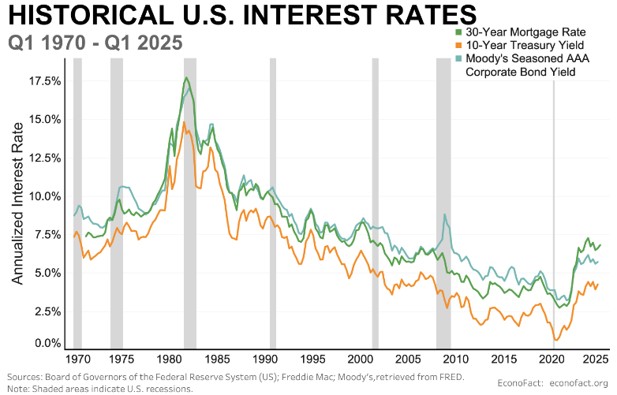
Interest Rate Armageddon - We might have a brand-new Fed Chairman, but Kevin Warsh has the same problem of sticky inflation to contend with. While the current 10-year Treasury yield of 5.3% represents a dramatic shift from the near-zero interest rate environment of the previous decade, it is historically well within the realm of normal for a healthy, growing economy. For much of the late 20th century, benchmark yields routinely hovered around or above this level without halting economic expansion. A 5% yield typically signals robust nominal economic growth, driven by solid productivity, sustained consumer demand, and real economic activity rather than stagnation. Instead of indicating an impending economic collapse, it reflects an environment where capital has a non-zero cost. This forces businesses and financial institutions to allocate capital more prudently and efficiently toward productive enterprises instead of speculative assets.
Interestingly enough, we are still below the 50-year average of 5.5% on the 10-year yield. So, a march a bit higher in rates wouldn’t be unusual. However, we wouldn’t be all that surprised if the executive branch tried a trick or two before the mid-term elections to attempt to stall or even reduce longer-term interest rates. Affordability is a major concern for voters and mortgage rates are tethered to the 10-Year US Treasury rate.
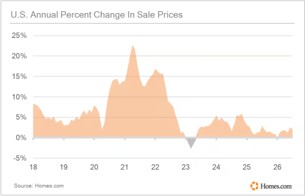
Real Estate Collapse - If you listen to the headlines right now, you’d think the real estate market was walking straight into a horror movie. While monsters and ghouls dominate the neighborhood doorsteps this October, the rumors of a looming housing crash are nothing more than a cheap Halloween costume. While high home prices and ever-increasing mortgage rates are spooky, there are a couple of market dynamics that should prevent a massive decline. First of all, the national unemployment rate is historically low at 4.1%, so most homeowners have income to pay the bills. They also have a record-high $25 Trillion in equity built up in their homes. With over 80% of mortgage borrowers locked into mortgages with sub-4% interest rates, there is a golden handcuff effect that is keeping listings sparse. Additionally, because new home construction remains well below long-term demand from younger generations entering household formation, a wave of underwater homes is unlikely. Now, obviously, the housing market is very dependent on local dynamics, and it is hard to paint the whole sector with the same brush, but here in North Carolina, the national story matches the statewide market. Metro areas like Raleigh-Durham and Charlotte continue to see massive job creation and tech relocations ensuring that housing demand replaces outgoing sellers. NC statewide inventory sits at a healthy 5.81 months, which is squarely in the stable/balanced zone, and average sale prices are 97.8% of list price, which indicates a housing market that is not seeing massive discounts to move inventory. So, while high-end properties ($875K+) may be softening a little, the mid and lower-end market appears to be tight and competitive and should keep a floor under housing values. The days of property values growing above trend are likely long gone, but at the same time don’t expect a collapse in values akin to the 2008 housing bust.
$10+ Gasoline Shock - Speaking of mortgage rates, it’s starting to feel like filling up a tank of gas is a mini mortgage payment. While inflation headlines have been trying to scare us all season, a nation-wide double-digit gas price is nothing more than a ghost story. Global conflict in the Middle East has led to prices at the pump reaching a record high $4.48 per gallon, but supply/demand and seasonal dynamics should prevent another dramatic spike from here. When prices reach extreme levels, demand destruction happens. Drivers switch to carpools, or mass transit, or hold off on that trip they were thinking about. This natural drop in demand causes the price to cap out long before the mythical double-digit range. On the supply side, the closure of the Strait of Hormuz for much of the conflict in Iran has greatly cut down the volume of oil passing through that international chokepoint for several months. This supply shock has led to crude oil staying close to $100 / barrel for an extended period. However, more recently, traffic through the Strait is getting closer to normal volumes. Were this dynamic to change to the negative once again, oil prices are likely to rise in the short-term, but the United States is still the largest producer of oil and gas in the world and is not subject to this disruption. Domestic production of gasoline also changes seasonally. With the peak summer driving days behind us, the country naturally transitions to lower demand in the Fall, as well as a cheaper winter-fuel blend at refineries.
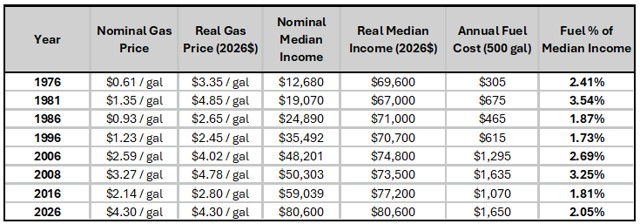
Even though fuel prices feel like they are running amok, they aren’t the highest we’ve ever seen in inflation-adjusted terms. In fact, we have seen higher peaks during the 1981 energy crisis, 2008 financial crisis, and even recently in the post-pandemic peak of 2022. Also, while gasoline prices have increased meaningfully over the last 50 years from $.61/gallon in 1976, the U.S median household income has also climbed significantly. In reality, we are spending a very similar amount (roughly 2%) on fuel now as we did then. So, go ahead and treat yourself to that autumn road trip to see the leaves change and don’t get tricked by the fear of double-digit gasoline or any other doomsday tales.