
They say the hardest thing to do in all of sports is hitting a baseball. As if timing a 90 mph curve ball isn’t hard enough, there is a sweet spot on a bat that is only about two inches big. Hit that sweet spot and you’re potentially earning yourself a leisurely jog around the bases with a home run, but miss it and you’re weakly grounding out to the infield.
The complexity of tax planning in retirement is starting to feel a lot like hitting a baseball. Finding your financial sweet spot isn’t about swinging wildly for aggressive loopholes or, conversely, sitting on the bench and doing nothing. It’s about timing and precision. It is vital to position your income, deductions, and investments so they connect perfectly with the tax code. When you hit that sweet spot, you aren't just saving a few dollars; you're launching your long-term wealth into the bleachers while keeping the IRS from spoiling your summer peace of mind.
To tax plan like a big leaguer, first you have to fully understand how income is derived and treated in retirement. Most income is classified as either ordinary income or investment income. Ordinary income consists of money earned through active employment and also future income sources derived from work, such as payments from Social Security, a 401k, or a pension plan. On average, about two-thirds of income is ordinary income.
Investment income is money generated from financial assets. This can include profits from selling a stock, savings from an investment account, or gains from real estate.
For the most part, ordinary income is taxed at your marginal income tax rate. The higher your income, the higher your tax rate on each new dollar earned. Capital gains and dividend payments can be subject to much more favorable tax treatment. The tax burden from this form of income can potentially be half as much as ordinary income rates.
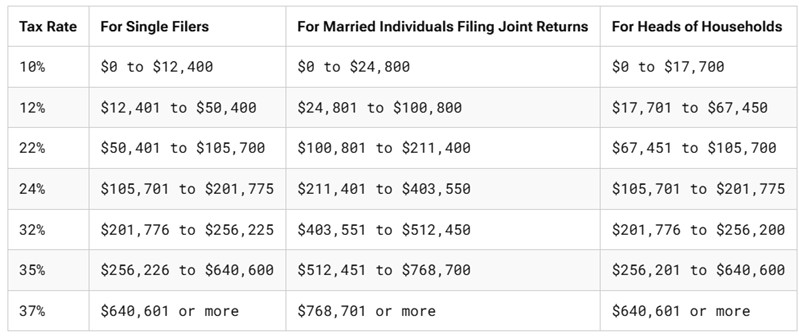
On the income tax schedule the gap that should stick out to you is the difference between the 12% and 22% tax brackets. The jump is a whopping 83% difference, and none of the other increases along the tax schedule are anywhere near this. So, if you are a joint couple with taxable income under $100k, you might want to consider “swinging harder” and generating more income to be taxed at that low 12% rate. The most common ways to increase income are via Roth IRA conversions or accelerated payments from your IRA.
Not everyone will have the income flexibility to income max through the 12% tax bracket. In a baseball at-bat you may only get one good pitch, or none at all! Depending on when you turn on Social Security and pensions you may be able to give yourself more good pitch opportunities. For example, lets take a 65-year-old newly retired couple of which only one of them has elected to turn on Social Security payments giving them $60k of total annual income. If they have the savings to support it, this couple can do $40k in annual Roth conversions at the 12% tax rate for five years while letting Social Security ratchet up to the age 70 maximum value. This tax planning opportunity is potentially lost if both of them turn on Social Security at age 65.
If Uncle Sam only threw fast balls, then retirement income tax planning would be fairly simple. Unfortunately, he has a nasty curveball hidden in your Medicare Part B payments. Depending on income level, your health care premium may cost you three times more in IRMAA (Income-Related Monthly Adjustment Amount) surcharges.
Planning around IRMAA is a multi-year process as there is a two-year-look-back on your income to derive your current fee. Additionally, if you wait too long then your IRA RMDs (required minimum distributions) or the death of a spouse can easily double your Medicare payment from $200 to $400 per month.
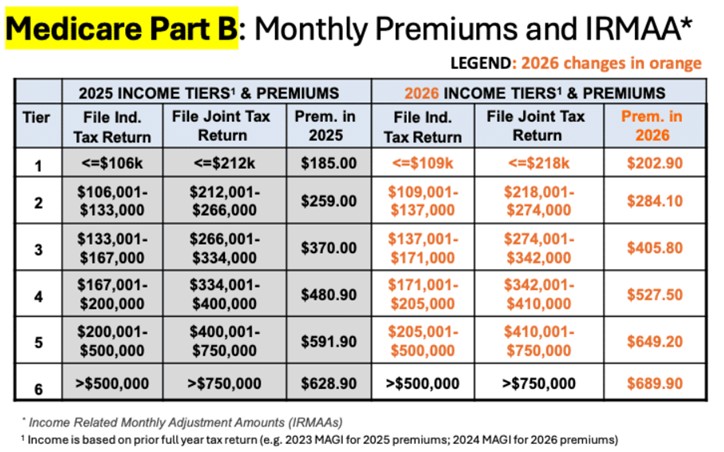
There are really only three ways to plan around IRMAA increases. The first is to accelerate income out of IRA accounts and get them into after tax accounts with more tax control. The second route is to donate IRA payments to charity. A QCD (Qualified Charitable Distribution) goes straight to charity from your IRA, and thus never shows up on your income taxes. Of course, you never see the money either which may be a deal-breaker. The third, and least palatable option is to just bite the bullet and pay up. Is a several thousand dollar annual surcharge annoying? Absolutely it is, but in the big picture it is about the equivalent of a 2% marginal tax rate increase, so it shouldn't be the sole driving factor in your retirement plan.
Finally, and potentially for only a short time period, there is the enhanced senior standard deduction. Marketed by Republicans as “no tax on Social Security”, seniors age 65 and up have a standard deduction (normally $16,100 per person) increased $6k each for single filers with income under $75,000 and joint under $150,000. This provision sunsets in 2028, so look for it to be a political talking point for the next presidential election cycle. For a couple in the 22% tax bracket this enhanced deduction is worth $2640 in annual savings.
So, where exactly is the income tax sweet spot? As with all things financial, the answer is “it depends”. The important income thresholds to plan around for individuals are at the $50k, $75k, and $109k levels, and for joint filers those marks are double at $100k, $150k, and $218k. If you find yourself near any of these spots then it is increasingly important to review your income planning. Learning to hit a baseball takes a lot of time and effort, and there are no shortcuts. Proper tax planning is no different!